Pux Ray
One RTX 4090 serving 41 models — image, video, audio, 3D, and LLM — through a single OpenAI-compatible API.
Pux Ray (tech-noir-ray) is the home-lab AI platform: one RTX 4090 (24GB),
64GB RAM, Ubuntu with LUKS, on Tailscale — serving 41 models through a
single OpenAI-compatible gateway. Images, video, audio, speech, 3D meshes,
motion, and LLM chat all resolve through /v1/* on one Traefik ingress.
The honest constraint
One GPU. Only one DiT model fits at a time, and the architecture says so out
loud: Forge keeps a per-service VRAM ledger — 24,576MB total, 2,048MB
reserved, 22,528MB available, 4,096MB minimum headroom — reads real free
VRAM via torch.cuda.mem_get_info, and evicts largest-first only when a
load needs the room. PIPELINE_LOCKED services are never evicted. The
core is Ray-free and unit-testable; 30 test files cover forge, ingress,
and the VNCCS pipeline.
Four-tier pools, configured not coded
The routing brain is one YAML file, config/inference_pools.yaml: every
model maps to a priority-fallback chain across four tiers — specialized
C++ dockers (llama.cpp, acestep.cpp, ComfyUI, CrispASR, openmoss), then
vLLM-Omni for the heavy DiT models, then SGLang, then Diffusers. Adding or
relocating a model is a config edit; no Python changes. Health-checked
fallback means a dead tier degrades to the next one automatically.
The benchmarks live next to the code, including the failure boundary: Z-Image renders 8 steps in 1.61s on the 4090; Wan2.2 VACE T2V runs 640×480 in 14.78s at a 23.3GB peak (re-verified; the first write-up said 15.42s) — and the config documents that 832×480/33-frame/20-step OOMs at BF16, with the fallback path written down. CrispASR hits 9.19% DER joint ASR+diarization; TRELLIS.2 loads in 41s and returns a 512³ mesh as an 18.7MB GLB in 24.1s; Kimodo warm inference is 0.79s for 60 frames.
One API, schema-driven everywhere
The gateway speaks OpenAI — chat completions, image generations, audio
speech/transcriptions — plus pool-control endpoints (/v1/inference/pools,
start/stop, model resolution) and a unified /v1/run. Behind it, a
34-service registry carries params_schema that auto-generates the
editor's forms; the repo rule, enforced in commits, is that the frontend
never hardcodes a service or model list — the backend schema is the only
source of truth.
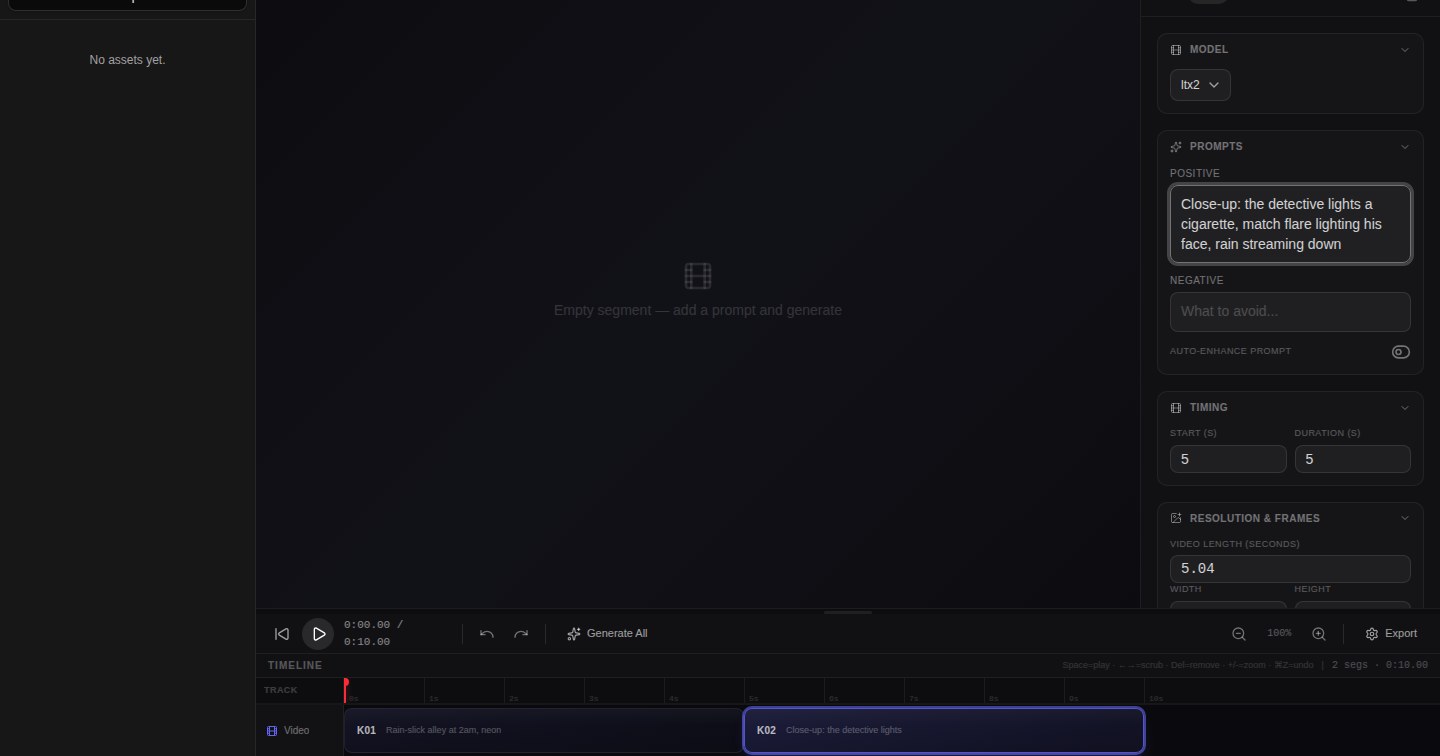
Six MCP servers expose the platform to agents: media-analysis (21 tools — Florence-2, YOLOv8, SAM 2, Pyannote), web-research (18 tools), finance, DAG workflows, and inference control — plus MCP Apps, so a browser card like Video Director is itself an MCP surface.
Operated like production
Flux reconciles layered Kustomizations in dependency order with health checks and self-healing; secrets are SOPS+AGE-encrypted in-repo; Renovate and kubeconform run through Gitea Actions and pre-commit; a private in-cluster registry serves the images; llama.cpp and its BeeLlama fork are built from source for CUDA compute capability 89. When a run needs more than the box has, a SkyPilot overflow gateway bursts to cloud and autoscales 0→8→0 replicas.
// more work
Melite
An agent media-creation kit — agents compose cards on a shared bench, the estate validates one run at a time against ComfyUI.
PUX
A personal agent platform through five architecture pivots — what survived every rewrite was the isolation engineering, not the framework.
Deep Research Engine
A six-node research graph — typed critic gate, self-describing knowledge graph, nine artifact schemas.
audiocore
One C++17 binary serving MOSS-TTS, Qwen3-TTS and ACE-Step through an OpenAI-compatible API — ggml backends, GGUF only, no Python on the inference path.