audiocore
One C++17 binary serving MOSS-TTS, Qwen3-TTS and ACE-Step through an OpenAI-compatible API — ggml backends, GGUF only, no Python on the inference path.
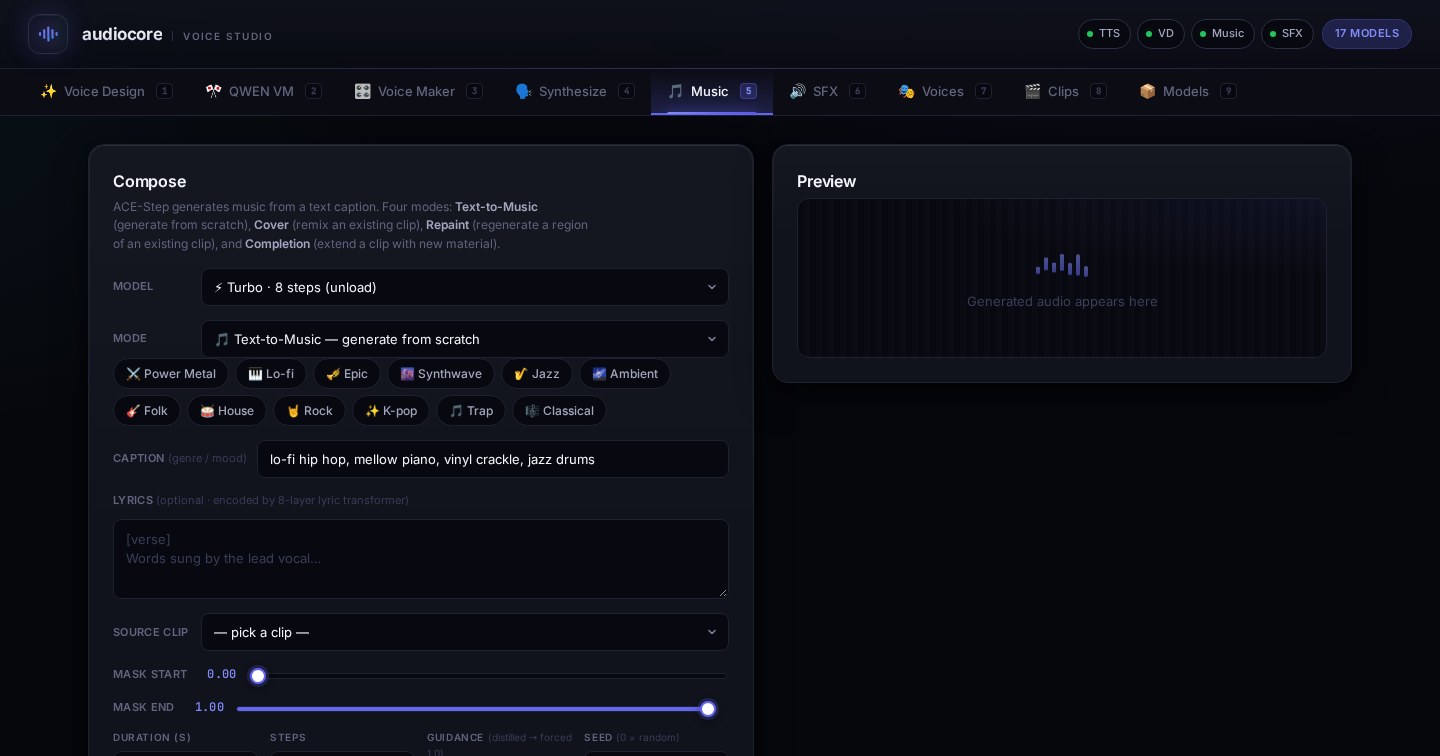
audiocore is a single C++17 binary that serves three audio model families through an OpenAI-compatible HTTP API — MOSS-TTS (8B) for speech, voice cloning and streaming; Qwen3-TTS for multilingual speech with style instructions; ACE-Step 1.5 for text-conditional music, repaint, completion and cover. 27.8k lines, 187 commits, no Python on the inference path, no separate frontend process.
One binary, four OpenAI-compatible endpoints
/v1/audio/speech, /v1/audio/music, /v1/models, /health — plus
sixteen more routes behind the Voices and Clips labs (blend, shift,
discover, extract, analyze, rate, score), plus the embedded Voice Studio
app served at / from the same process. That app is
not a demo stub: voice design, synthesis, music, SFX, a Voice Maker
(blend / shift / discover / shape), Voices and Clips libraries with
drag-and-drop, PCA voice-space analysis, and a models manager that hot-loads
and unloads weights without a restart.
GGUF is the only weight format
server.json → main.cpp → FamilyRegistry → Session { WeightLoader + Backend }
                                              │
                                              ▼
                                        GGUF reader
                                              │
                                              ▼
                                    TensorStorage
                            (format-neutral descriptor)
WeightLoader is the single seam between file format and model code, so a
new family never re-implements a reader. The GGUF reader itself is vendored
from leejet/stable-diffusion.cpp (MIT, attributed in the reader's file
header) —
proven code, not a rewrite.
Three families, one backbone
MOSS (8B), ACE-Step (1.7B LM + 0.6B text encoder) and Qwen3-TTS (Talker +
code predictor) all run through the same qwen3::Runner on llama.cpp, and
every family — plus the MTP predictor — samples through one
audiocore::sampler::sample_token. One TtsRequest struct means
/v1/audio/speech has one code path, not one per family. Backends are
per-slot: several models can be configured in a single server.json, each
with its own ggml backend (CUDA, Vulkan, Metal, CPU) and its own session.
The MOSS port keeps the model's 32-RVQ delay-pattern state machine intact — top-k, top-p, repetition penalty and all — because audio quality dies at the sampler, not at the graph.
Verified against real weights, and honest about what isn't
models/manifest.json is the canonical record — HuggingFace repo, revision,
file list, license, supported modes, min_vram_gb — and the binary can print
its own matrix (audiocore_cli --list-supported).
| Family | Verified end-to-end | Fails fast by design |
|---|---|---|
| MOSS-TTS (8B) | tts, voice_clone, voice_design, streaming, sfx | dialogue — needs the dialogue checkpoint |
| Qwen3-TTS | voice_clone | streaming — fails fast at the transport; voice_design, batch TTS and style-instruct are partial — best-effort on Base, true fidelity needs the dedicated checkpoints |
| ACE-Step 1.5 | text_to_music across all six DiT checkpoints (RMS ≈ 0.0229) | repaint, completion, cover — sampler code shipped, manifest-gated pending e2e; stem, lego — need a Demucs-style assembler |
Unsupported modes return an error naming the missing checkpoint instead of
producing degraded audio. ctest covers GGUF round-trips, the family
registry, audio-head projection parity, sampler behavior, server HTTP e2e
and the ACE-Step converter; the full-weight load tests stay outside ctest
because they need mounted checkpoints.
The provenance is stated, not implied
audiocore borrows 0xShug0/audio.cpp's architecture clean-room — it is
not a fork — and vendors two things it would be worse at writing itself:
sd.cpp's GGUF reader — adapted into src/framework/io/, attribution in
its file header — and ggml/llama.cpp under third_party/, which keeps
original license headers; the project is Apache-2.0. A vendored copy without
attribution is how a codebase stops being yours.
Quick start
git submodule update --init --recursive
cmake -S . -B build -DENGINE_ENABLE_CUDA=ON -DENGINE_BUILD_TESTS=ON
cmake --build build -j
./scripts/fetch_models.sh --list        # the mode matrix, from the manifest
audiocore_cli --list-supported          # the same matrix, from the binary

docker run --rm -p 8080:8080 audiocore:cpu   # Voice Studio at :8080
curl http://localhost:8080/health            # {"status":"ok"}
// more work
Melite
An agent media-creation kit — agents compose cards on a shared bench, the estate validates one run at a time against ComfyUI.
Pux Ray
One RTX 4090 serving 41 models — image, video, audio, 3D, and LLM — through a single OpenAI-compatible API.
PUX
A personal agent platform through five architecture pivots — what survived every rewrite was the isolation engineering, not the framework.
Deep Research Engine
A six-node research graph — typed critic gate, self-describing knowledge graph, nine artifact schemas.